
By: Kofi Agyei, Armaan Sachdev, Adina Shrestha, and Ashleigh Mock
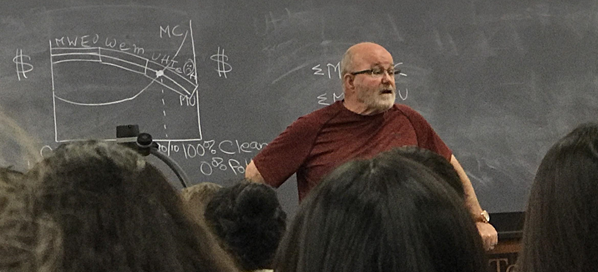
What do you want to be when you grow up? It is a commonly asked question for our age group. But does anyone actually have an answer? During our discussion of careers today, lead by the on-site director, Jeremy Elliott-Engel, we discovered what it meant to have a career. Jeremy told us that the definition of a career is a series of jobs which will change over time. He also emphasized that our career should not be about the title or the salary but about the experience and skills gained and our contribution to society.
With choosing a job in our culture today, there are a number to choose from. There is a National Career Clusters list which categorizes every type of job under one of these 16 career clusters. The shocking part about this for the majority of us was that agriculture is a part of every single one. Jeremy challenged us to find a single career cluster that would not fit into agriculture. Though many tried to find a fault with his bold statement, Jeremy was able to connect every single job back to agriculture.
Here is the official list of career clusters: https://careertech.org/career-clusters
Jeremy also taught us the importance of networking. Networking means to interact with others. It means to actually look up from your phone and have a real conversation with another human being. Scary, right? He taught us this through a fun, interactive activity, “Who Wants the Same Career?” He also gave us some guidelines for how to network properly. For example, do not be aggressive, do not be creepy, and present yourself as authentic.
 to that trendy

 the efforts needed to get a carton of milk on the table. We first visited the calves, at the Calf Center. This is where the calves are kept. They first are placed in individual pens called hutches. Eventually they are placed with other calves and are fed by an automatic system that scans the tags on their ears. The scan tells the machines how much to feed the calves. When the calves are old enough, they are weaned off of the colostrum (a
  special milk that the mothers produce) and placed in another area in the calf center to begin eating a special mix of corn, hay, soybean meal, and minerals. Once they are old enough, they head to the milking parlor. Kentland Farms operates a parallel milking parlor. In this parlor, the cows are lined up in two rows with their rears facing each other. The
 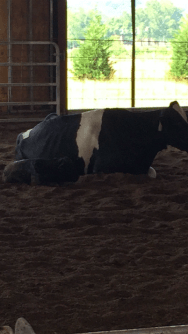 space between the two rows is where the dairy farmers set up the claws to obtain the milk from the cows. The manure pit was an essential part of the farm, as it provided the proper plumbing and sanitation for the cows. The cows can excrete whenever and wherever they please, and every hour or so there is a stream of water that flushes out all of the manure. From here, all of the waste gets flushed out to the two circular places toward the backend of the farm, where a motor constantly mixes the manure. After the sand
  and dirt is separated, a truck collects the manure and uses it as a natural fertilizer, creating an efficient system. Some of us had the privilege of witnessing a live birth in the special needs barn. Originally, the dairy farmers were concerned that it would be a difficult birth, but fortunately both the mother and calf were fine. Mr. Dave Winston, the leader of our group at the dairy farm, commented on how we “lucked out” with the incredible timing of our tour.
 Governor's School for Agriculture