
By: Marissa Yee, Jacob Cody, Teddy Daniel, Maria Baig
The Values of Vapor 35
Drones have become a vital component of the agriculture field of study, primarily 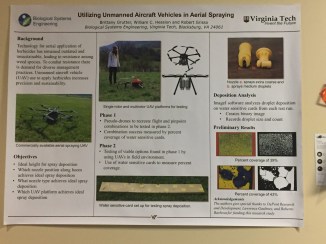 because they have such a wide variety of applications. In agricultural research, drones help measure fields for numerous useful qualities: canopy height, leaf area index, and the size and shape of streams over time. Today, Virginia Tech is using an Unmanned Aerial Vehicle (UAV), called Vapor 35, to map floodplains and inundation (floods) using the LiDAR imaging system. The LiDAR system has many functioning components: a yellow scan core system, multi-echo system, calibrated IMU, an embedded computer, data pre-processing system, ground control station software, onboard avionics, and heat sensors. The complexity of the LiDAR system allows for consistent data collection, simple navigation and flights, and in depth photographing of the region.
Exciting Experiments
In order to experiment with the abilities of drones, Virginia Tech has implemented new experimental techniques. One such experiment is the pseudo-drone; the drone is attached to a pole on a John Deere tractor, allowing factors like height, nozzle type, nozzle position, and more to be altered in a controlled manner. This eliminates the need for expensive and time intensive test flights. Researchers have used information collected to optimize the drones’ ability to spray fertilizers, pesticides, herbicides, and more on fields, reducing negative effects of pollution like algae blooms and increasing yields.


 found in raw milk, such as
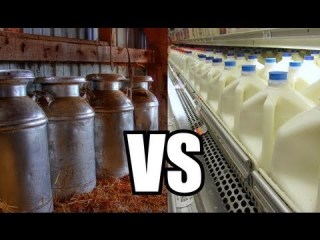
  pasteurize milk so that it is safe for people to drink! There are two different pasteurization methods: batch and continuous. In batch pasteurization, milk is heated in a large vat to 145°F for 30 minutes to effectively kill the bacteria. In continuous pasteurization, however, the milk is never stagnant in a container, but is pushed between a hot pipe to heat it up in a method known as High Temperature, Short Time (HTST). At this point, the milk’s temperature can range
  Administration (FDA)
 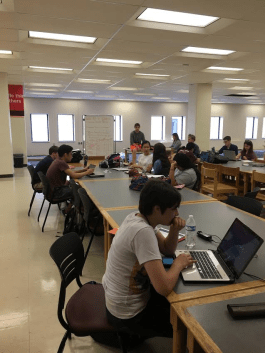 a topic related to current agricultural issues in the world, and have to answer an in-depth question while incorporating the concepts of engineering, science, and economics. Students were divided into groups of five people with mixtures of different interests and majors in each group. By the end of the month each group is responsible for a poster, brochure, 3D printed object, and paper to be presented at the symposium. In the first few days, students have began to create plans of work and lay out the rules for their teams. They also created an outline for the first drafts of their 10-page research papers.
 to agriculture. The emissions are not only related to agricultural production itself, like livestock or rice cultivation, but are also related to transportation and other industrial aspects. Another group in food safety is analyzing whether food donation programs such as the WIC are beneficial and what alternatives are possible for it.
 Governor's School for Agriculture