What will the future look like?

Coming into Governor’s School I wasn’t super ecstatic to be here.  I was interested in agriculture as a whole and I understood how important agriculture is to our daily lives but besides that, I honestly thought it was dull.  I envisioned a summer of harvesting corn or milking cows, which would all be great experiences, but I didn’t expect to be learning about the technology that runs the agricultural field. 

We learned about how drones are being developed to aid in precision agriculture, how plants can be grown without soil, and we toured a lab that has million-dollar machines that can determine exactly what the genetic makeup of a substance is.  We also learned of the importance of these developing technologies because we will not be able to feed the growing population if we continue to farm as we do today. 

The population is estimated to reach its maximum by 2050, approximately 10 billion people, and we do not have the land to grow crops and house that amount of people.  This slightly frightened me but also fascinated me because we have no other option but to advance our agricultural practices. 

What would the future look like?  Would it be filled with massive vertical farms, drones that can diagnose and treat plant disease, and robots that will fully automate the growing process? Or would it contain some unknown technology that will change how we live our lives? Who knows, maybe we will just live on Mars.

-sg 

Cows and Engineering

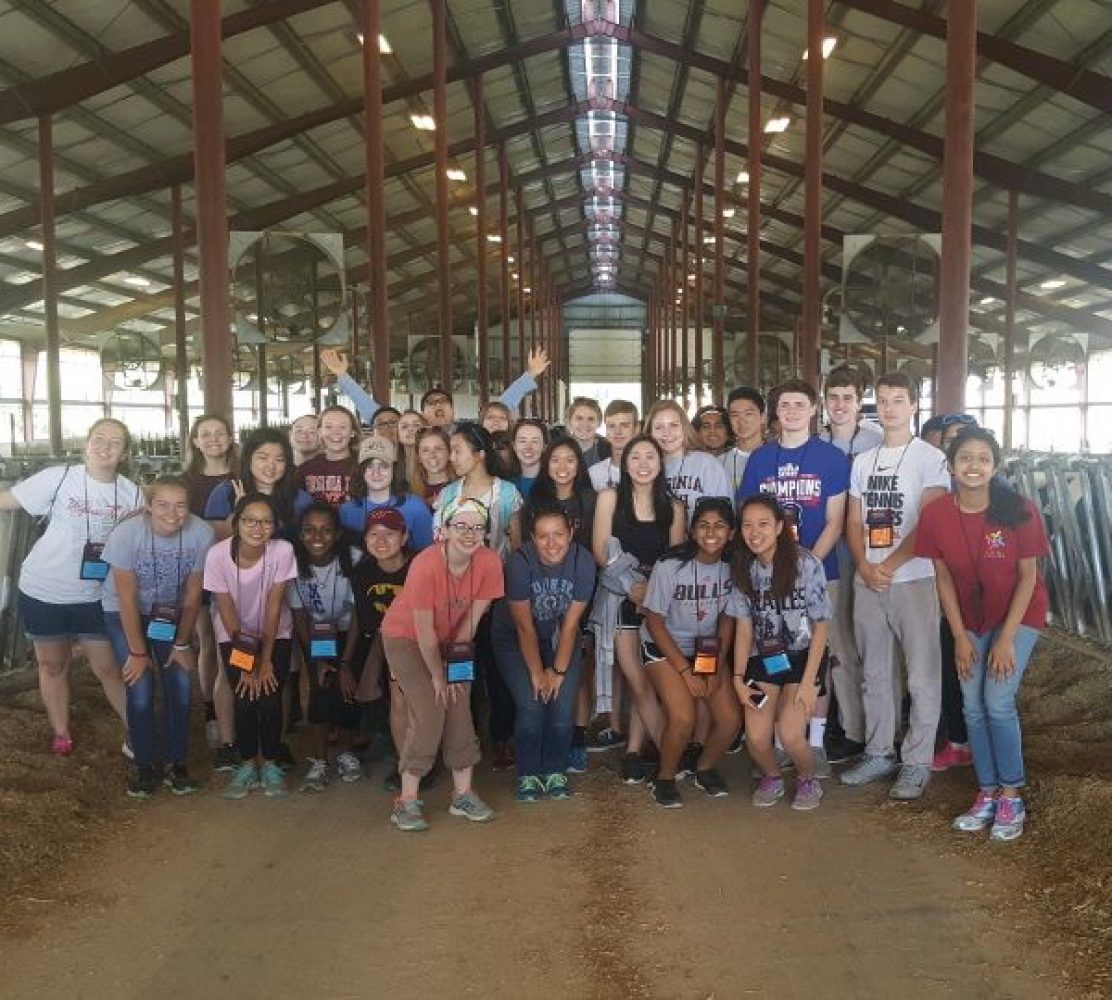
When I first heard I was accepted into Agricultural Governor’s school, I was a little nervous, and rightfully so. I had never been interested in agriculture or farming, so I didn’t know what I was getting into. The truth is, I’ve never even seen a cow up close before. Until now. When we first got to Kentland Farm, my group was looking at the fields first, which wasn’t that exciting to me.

My real goal of the entire month-long trip was touching a cow. The first time I touched a real live cow, I was shocked. Especially when one of the calves started licking my hand, and I found out the hard way that cows have extremely rough tongues. The calves were basically like giant dogs. The adult cows, on the other hand, were a little less friendly. That didn’t stop me from trying to pet them though!  My goal was complete, and I had felt satisfied in life.

Seeing the production of milk was just as exciting as the cows, in all honesty. Whenever I had imagined milk farms, I always imagined some old farmer in overalls sitting on a stool and manually hand milking the cows.  I never even imagined anything different, so when I saw all the machinery and technology that goes into it, I was blown away. As somebody who is very interested in engineering, it opened my eyes up to a whole new level of integrating agriculture and engineering. 

-jd

The Food We Eat

The welcome breeze in face of the burning sun, the faint smell of fertilizer, and the distant hum of the diesel engine. I could tell with my eyes closed that I was on one of the many fertile farms that grace the lush valleys of western Virginia; but this was not just any farm. I was at Homefield farm- the organic research farm of Virginia tech- one of the many exciting, hands-on field trips I got to participate in through the Governor’s School for Agriculture at Virginia Tech.

We were given a private tour of Homefield by the farm manager, who showed us many of the components of a successful organic farm. He showed us everything from the implements, the crops themselves, and the various sustainable pest control methods which Homeview employs. The farm manager even took the time to run us through the whole food processing cycle, from harvesting to delivery.

We were able to see where the food we eat in the dining hall comes from, as well as various experimental plots on which professors are conducting research on. When we finally loaded back up into the buses, I had a deeper level of understanding for the work which goes into all agricultural operations; and a new appreciation for those who engage in the arduous process that ultimately delivers food to the table.

-tm

Cow Goes Moo

I think you’ll agree with me when I say: “Cow farms smell insanely bad!”Stepping into a wooden building (usually the red ones), smelling the mix of fresh straw, festering manure, and spoiled saliva. If you’re not used toit, it’s not exactly a great start to a day, muchless an end to a laborious one. The first time we visited Kentland Farms, as our tour guide introduced us to the calves, there was a multitude of smelly dust billowing out at us.It got in our clothes, our bags, and our eyes, at which point many people started to keep their distance from the barn.BUT are these smells worth your while? Only a very small percentage of people know that a large contributor to the exquisite smell of dairy farms is a large number of endotoxins released through the collection of bacteria, specifically those involved in decomposition. Why would we ever want to breathe in a compound that has “toxin” in its own name?Well yes, large amounts of endotoxins are extremely harmful to any living organism, and humans are no exception.This particular type of endotoxin, however, elicits an immune system response similar to that ofdust, but instead of constricting our airways, we release a compound called A20. This enzyme provides us with temporary protection against pollen and dust allergies, and in some cases, even asthma (Danovich, 2015). Please, please, please do NOT go to your local dairy farm, set up camp there for the next decade, and start inhaling as much saturated air as possible. Everything has positive elements and negative ones, so not only will you look like a complete idiot and probably get banned from going there ever again, but you’ll also get sick after inhaling it for 10 to 20 years.As with any type of foreign substance, your body needs time to construct a response (HopkinsMedicine). The immune system is simply not built to handle a large outbreak of very distinctive smelling toxins, so if you introduce a large amount suddenly… Well, we don’t know what other particles might be lurking in there. So what can we, as a community, do to help refine this cow dust into a cure for allergies?

-jh

Citations:Danovich, T. (2015, September 8). It May Not SmellGreat, but Dust From DairyFarms Could Have Health Benefits. takepart. http://www.takepart.com/article/2015/09/08/farm-dust-health-benefitsJohns Hopkins Medicine. (n.d.). The Immune System.Hopkins Medicine.https://www.hopkinsmedicine.org/health/conditions-and-diseases/the-immune-system