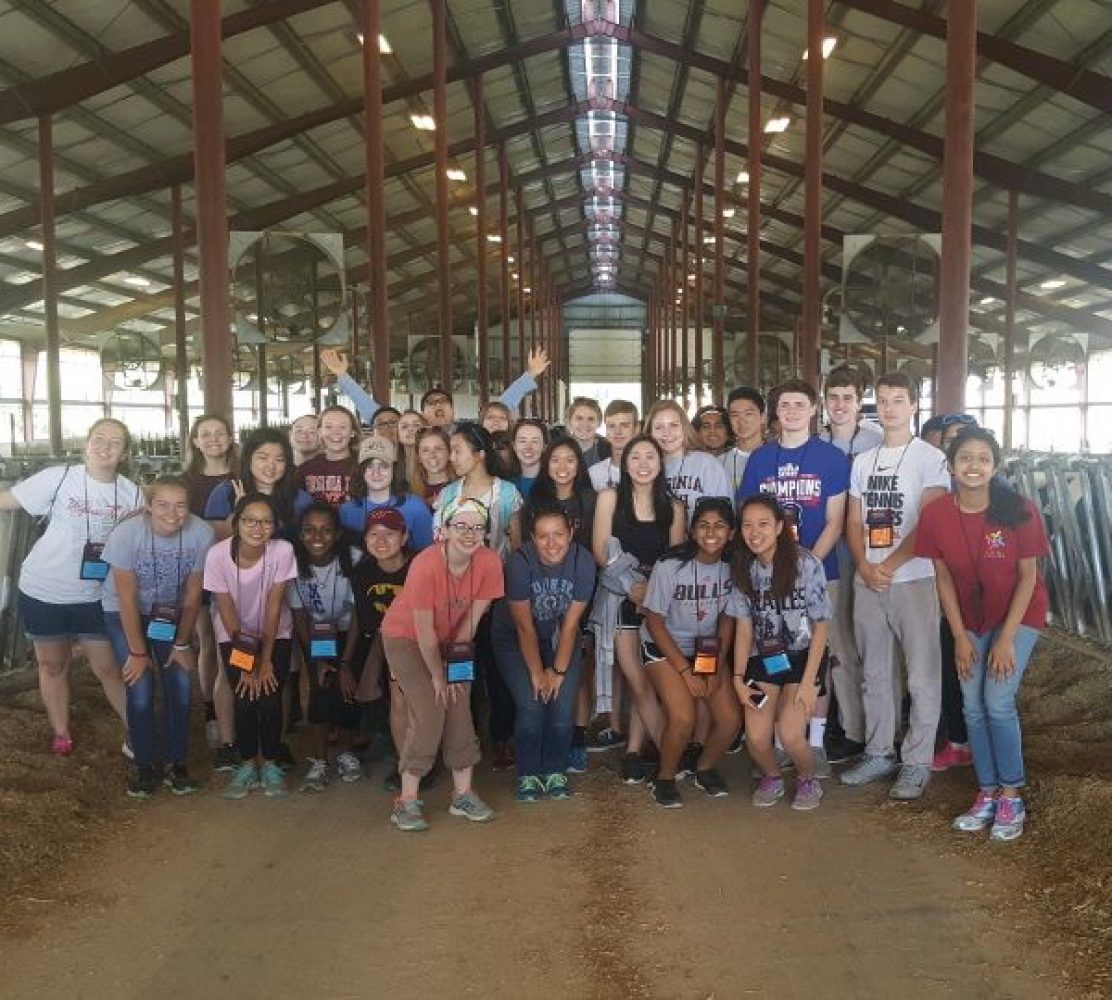

By: Emily Resau, Emily Sheng, Madeline Johnson, and Lindsay Hanks
For animal science this week, we have been visiting the Virginia-Maryland College of
Veterinary Medicine on campus. At the vet school, we met with veterinarians, current students, and technicians. They gave us tours of the facility and an opportunity to learn more about veterinary medicine.
Clinical Practice
On Tuesday, we practiced in the clinical skills room. The clinical skills room is a
classroom that contains different stations that have various aspects of veterinary surgery, such as IV catheter placement and injections. The vet students demonstrated small animal CPR, large animal palpation, and clinical instrument handling.
Our favorite station was placing the catheters and practicing intramuscular injections. At
the catheter station, the vet student first gave us a demonstration of placing a catheter. It is first placed by inserting the needle in the vein, and when a flash of blood (for practice, blood is substituted by red food coloring) is visible, then you pull out the needle. Quickly following that, you insert a plug into the catheter to block the flow of blood. At the intramuscular injection station, we practiced inserting needles into the muscular areas the imitation dog they provided.
In order to insert an intramuscular needle, the vet first locates the muscle that is going to be injected. Next, the protective cover is removed from the syringe. Then, with the bevel in sight of the one who is injecting the needle, the shaft is inserted into the muscle at a ninety degree angle until all that is seen is the hub. The vet then pulls back the syringe to check for blood. If there is no signs that the needle has hit a blood vessel, then the vet pushes the syringe quickly to insert the vaccine/ medicine and pulls out of the muscle. If blood does appear, then the needle is removed and a new site is found.

https://www.youtube.com/watch?v=0VQK7tqystg this is a short video about placing a catheter into a dog.
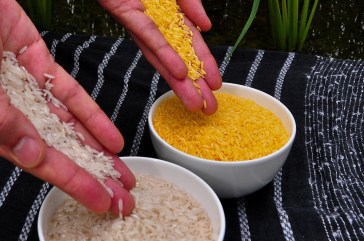
 This food is called “Golden Rice”, named for its slightly yellowish tint.
 Monsanto are monopolizing the production of such crops. However, this is not the case. Golden Rice is a feasible solution to an ongoing issue,with no proven signs of harmful effects.
 was turned and water began to spray from the suspended nozzle. The students were told that this was a rainfall simulator, and the boxes contained different materials that were possible runoff culprits. The purpose of the simulator, explained by PhD student Qualla Ketchum, was to observe the runoff amounts from 4 different mediums: straw, dyed mulch, soil, and grass. First, the students were asked to predict the amount of runoff that each medium would produce. After the simulation ran for about 25 to 30 minutes, it was observed that runoff was produced from the mud container first in a murky brown color. The next container that produced runoff was the mulch, which at first yielded brown water but at subsequent attempts became clearer. The chemical residue left from the dyed mulch proved to be more harmful at first due to h 0c gher pollutant concentration, but as time went by and more samples were collected, the water samples contained less pigmentation. Straw and grass were more absorbent,and therefore were the best mediums for runoff prevention.
 many PhD students conduct their research. Students waded into the water to witness the measurements of downstream velocity with university technology and aided with the turbidity test. In this test, students observed initial stream turbidity, then after kicking up rocks and stirring sediment, noted the diminished water quality in relation to high turbidity levels. Getting into the stream was the highlight of the day, due to the intense heat, around 95 degrees.. woaH.

 Governor's School for Agriculture