To Bee or not to Bee

l,

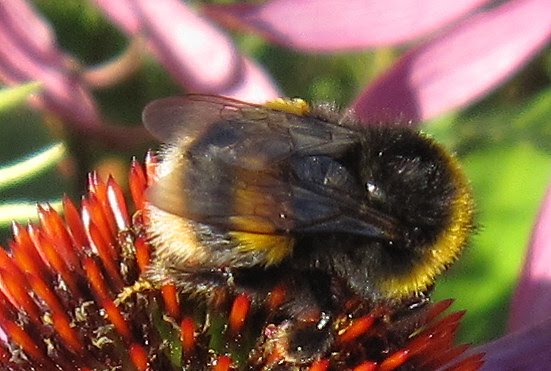
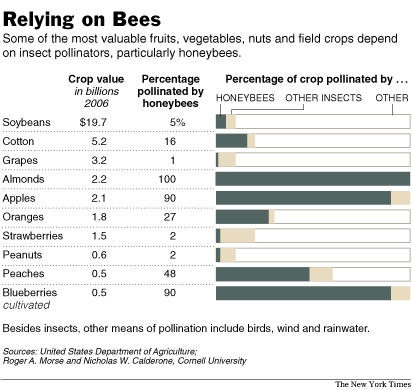
Within the last 20 years, the once thriving bee population has suddenly dropped significantly. In 2006, 40 percent of commercial honeybees were lost. Beekeepers all over the globe have especially noticed the disappearance in the honeybee population. Now you may be thinking that this decline in the bee population is beneficial because it means less bee stings, but bees are far more important to the world than you might initially believe. Contrary to popular belief, bees make much more than honey. Bees in general play a vital role in food production; bees pollinate the crops that are the basis for food production. It is estimated that bees contribute 15 billion dollars to the increase of crop value each year. Yes, the occasional bee sting can be annoying, but the overall benefit of bees surely outweighs the bee stings.

Interestingly enough, the major cause contributing to this reduction is commercial agriculture. The harmful pesticides that are being used by commercial farmers to kill unwanted insects are also having the same negative effects on the bee population. It is quite ironic that the pesticides used to help food production are actually contributing to the killing of the insects that are vital to food production.beestable
In most cases of bee deaths, it is in a mysterious way known as Colony
disorder (CCD). This involves all of the adult bees seemingly disappearing with no dead bodies remaining behind. The queen honeybee usually is still found alive, but the colony is destroyed with the loss of bees. It is not known what causes this problem, but many consider it to be the result of a number of issues. These mainly consist of pesticides, parasites, disease, and/or nutritional problems.

The pesticides believed to be the primary cause of these deaths are called neonics.  The most notable neonic is named imidacloprid and it is the most popular insecticide on the planet. These pesticides are share a similar chemical structure with nicotine and share its addictive properties. Starting in 2008 multiple studies began linking neonics with damaging effects on the environment including CCD. The bees are unable to taste the neonic and when they begin feeding they become addicted. After a large amount of it is consumed it begins to affect their fitness and prevents them from foraging for food. In the end the bee becomes too weak to find food and starves to death. In 2013, the EU and a few neighboring countries began regulating the use of neonics, but they are still widely used in America.

What can you do to help fight this issue? As an average citizen that does not keep a bee colony, you can refrain from using pesticides in a non-controlled manner. They should definitely not be used near a colony and you can try to not use them during midday hours when bees are active and about.

Written by: Nate Miles, Brian Blaine, Liam Snyder

Ready…Set…Roundup! What’s On Your Plate

Growing food to feed our increasing population has changed drastically in the past few centuries. With the advent of genetic studies, the agriculture jjlkindustry today does not even begin to resemble the family farms many people think of. Now, many chemicals, such as herbicides and pesticides, are being applied to cash crops to aid in growth and increase yield. This may sound beneficial to not only to the producer, but also to us, the customer. But this may not be quite so. With the rise of these chemicals, there is also a growing concern for the health of the environment and for those who consume them.

One of the most popular herbicides is Roundup, which has the active ingredient glyphosate and is typically used for soybean farming.

Well, what makes Roundup so bad?

  • Glyphosate can have unforeseeable long term side effects on the ecosystem and the human body that may wreck the environment for future generations.
  • It is often compared to “DDT”, an insecticide that is known to be very dangerous to the environment and has been banned in many countries.
  • Some researchers suggest that Glyphosate is actually WORSE than DDT, especially because it’s been shown it may be harmful to bacteria.
    • It is to be said that DDT chemicals should be minimized in application in commercial agriculture, according to research.

The Dirt on Bacteria

kl

If Glyphosate destroys bacteria, shouldn’t that be a good thing?

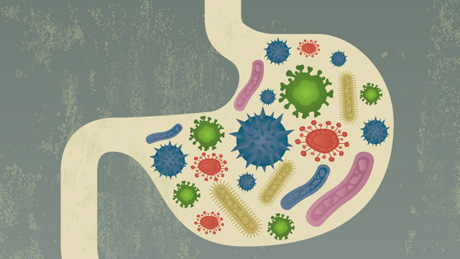
Well, despite the preconceptions that all bacteria cause harmful diseases that weaken our systems, bacteria is essential for our survival. We have bacteria on our skin, our mouth, and most important our gut. These bacteria aid in digestion and without them we would not be able to obtain the maximum nutrients from the foods we eat.

How does this affect me?

If we consume products such as soybeans with glyphosate residue, it may upset the delicate balance of the gut microbiota, which end up dangerous for us.kjnThe soybeans are genetically modified (which is another huge controversy in the agricultural field) to be resistant to the herbicides effects. However,

njklthough it has its benefits, like preventing weeds from taking up vital resources in the environment, it also has its drawbacks.

Imagine if we were not able to get the foods out of our bodies; now that would be uncomfortable! Not being able to digest food, obviously, can lead to many bad consequences. We have trouble digesting foods contaminated with glyphosate, causing extreme bloat and an inability to break down vital nutrients.

But, in the eyes of the government and some scientific institutions, glyphosate is deemed “safe” and “non-bioaccumulative”. This response then prompts an array of new questions:

  1. If glyphosate is the most popular herbicide, how much of it is in our food?
  2. When will the amount of glyphosate reach the threshold where our body cannot keep up with breaking it down?
  3. What are the serious long term effects of consuming foods contaminated with glyphosate?
  4. How can I protect myself from the negative effects?

I don’t know about you, but a chemical that has not been thoroughly researched for its long term bioaccumulative effects should not have a place in our food, let alone our bodies.

Next time you’re in the grocery store, stop and think about what unnecessary chemical residues your food may contain. It may surprise you.

Written by: Adia Williams, Lyndsey  Norberg, Sophia Xiao

Breakfast is Getting Egg-spensive

imrs

This year’s outbreak of avian influenza in the United States is one of the worst agricultural disasters our country has faced to date.  As of the summer of 2015, over 50 million chickens have been killed due to the virus, primarily in Midwestern states. Iowa has suffered the most losses to their poultry population, with more than 40 percent of the chicken population being affected.

Avian influenza, commonly known as bird flu, is normally carried by wild birds such as geese and ducks.  These animals have built up a resistance to the influenza virus; however, domestically farmed birds have no such protection.  Through connection of bodily fluids or fecal matter, the virus spread from one of these wild bird hosts to the defenseless chickens and turkeys in the American Midwest.

Once infected, chickens have a 90 percent rate of mortality within 48 hours, which has obliterated the population. Due to factory farming and its crowded conditions, the virus has spread uncontrollably from chicken to chicken and farm to farm, further escalating the problem.  While the losses are greater on farms with more birds, the viruses are nondiscriminatory and even the smallest poultry farmers are faced with its repercussions.

Unfortunately for farmers, the first clear sign that the flock is infected is the presence of dead birds. As the disease is so fast-killing, it is hard to notice any strange symptoms, which may include abnormally-ruffled feathers, low feed consumption, and a drop in egg production.  The most effective way for farmers to stop the spread of the virus is to isolate and eliminate all poultry exposed to the virus, clean up excess fecal matter, and sterilize all living pens.

The preventative measures put in place have not been effective in stopping the disease thus far. According to the USDA the virus has spread to 15 states within the past five months.  American farmers will most likely have to replace a high percentage of their birds as a result of the outbreak and its ghastly effects.

While the disease is deadly to the birds, it is certainly painful to the pocketbooks.  Grocery stores and restaurants are facing severe shortages in egg, poultry, and egg-product goods; including Texas-based grocery store giant H-E-B, limiting the number of egg cartons that may be purchased.

,MK

My mother, on our regular trip to the grocery store last week, noted that the price of a carton of eggs cost more than usual. Initially, my mother and I thought nothing of the matter, until we realized a trend among all chicken and egg-related products. My mother was agitated at the inflated prices of all the chicken byproducts and proceeded to ask the store manager the reason for the increase in prices. To our dismay we realized we were in the midst of a very serious epidemic, a chicken epidemic. My mother held an outstanding amount of sympathy for the chickens and eventually became the catalyst for this blog post.

In conclusion, I have realized that chickens play a pivotal part in our everyday lives. The glaring effects of the avian influenza epidemic seen in the local grocery store has made it easy to say, a world without chickens is a world without cake, omelets, and happiness. Viva la Chicken.

Written by: Ben Habermeyer, Jack Snowdon, Frank, Gordon

The New Printing Press: Bio Edition

The history of 3D Bioprinting is brief, for it is a new development that is still being tested for safety and is not yet commercially utilized. However, much of the research that contributed to the current early-stage development of 3D bioprinting is based off of tissue engineering research that has been taking place for the last forty years. Even before that, the study of cells and tissues stemmed from Anton Van Leeuwenhoek’s early microbiology studies on cells dating all the way back to the early 18th century.

In 2004, Organovo, one of the largest research groups dedicated to studying Bioengineering discussed the formation of their company around Forgacs organ printing technology. The Forgacs lab in Missouri had been doing extensive lab work over the last several years on the idea of printing cells to form organs. The first research patent on a platform entitled Self-Assembling Cell-Aggregates and Methods of Making the Same was filed in late 2005. Over the next few years, the company changed hands many times until a major breakthrough in 2010: Organovo described their work on a fully cellular blood vessel, demonstrating the ability to create novel tissues in 3D using only primary human cells. They soon partnered with Methuselah Foundation on Funding of Bioprinting Research at Research Institutions and were able to close a 46.6 million dollar research grant that allowed them to begin presenting prototype models of a human liver that was printed in 3D.

3D bioprinting is a groundbreaking technique that involves a precise procedure. The robotic arm of the bioprinter is first programmed to create a mold based on the organ to be printed. A matchbox-size triangulation K;sensor proceeds to determine the position of the first syringe to begin the printing process. The robotic arm of the 3D tissue printer moves the first syringe to fill the mold with living cells. The 3D tissue printer outputs living cells and a dissolvable gel that supports the cells during the printing process. After the printing process is completed, the well plate that contains the newly printed tissue is removed and placed in an incubator. The tissue on the well plate proceeds to fuse into an organ.

3D bioprinting has the potential to revolutionize medicine. Scientists have already begun to 3D print organs such as kidneys and bladders. At this rate, patients in need of an organ donation will no longer have to depend on the unreliability of organ donors; instead they will be able to have a new organ 3D printed. Not only will more patients be able to get an organ donation, but they will also no longer be at risk of an organ rejection because their 3D printed organ will have come from their own cells.

3D Bioprinting undoubtedly has numerous benefits and the capacity to save countless lives, but there are many concerns with this upcoming innovative 545medical process.  Since bioprinting is still new, there is no research on the long term effects of bioprinted materials on humans therefore there is no strong evidence that bioprinted organs is as effective and durable as transplanted organs.  How accessible will bioprinted organs be to the public?  Like any other medical treatment, bioprinting is expensive. Only those with health insurance and the upper class would be able to afford 3D Bioprinting, therefore exacerbating the gap between the rich and poor. 3D Bioprinting can also revolutionize plastic surgery, making it faster and cheaper.  This will change the ideals of society and create “immortal beauty”.

Written by: Emma Anderson, Madison Ojeda, Megan Nquyen