You are what you eat: Food safety from different perspectives

By: Edward Cho, Mitchell Turnage, Lawrence Wang, Nejib McGill

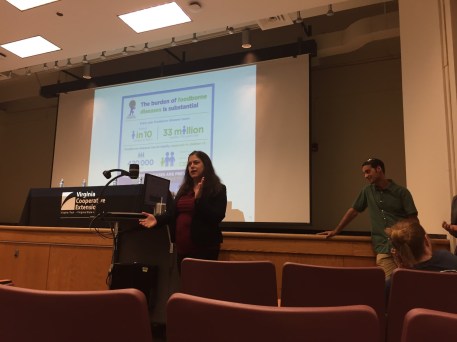
This past Thursday, July 7th, students had the opportunity to observe a panel, with members discussing the topic of food safety in America. They heard plenty of unique and educated perspectives regarding the topic and learned a great deal about how critical food safety really is. The importance of this issue is essential to understanding the necessity of passing an acceptable threshold of “cleanliness” for the public.

The four different individuals specialized in different areas of agriculture:

  1. All natural raw dairy
  2. USDA
  3. Food Safety
  4. Traditional dairy

Food Safety.1

Many students entered the panel discussion with little to no interest or prior knowledge on the significance of food safety and its relationship with the public health, molding an unexpected and interesting discussion. However, upon the conclusion of the panel, many students had completely changed opinions on food safety, largely a result of the myth-busting that took place concerning the misconception of food treatment and distribution.

Food Safety.2

A significant takeaway from this panel was the overarching theme: food is never safe. The speakers pointed out a distinctive difference between the safety and acceptance of certain foods distributed throughout the agricultural industry. Additionally, the myriad of backgrounds and occupations of the speakers presented multiple misconceptions that are commonly held ignorant by the public.  One of the heavily discussed debates during this panel was over the potential and known benefits of raw milk.  The organic farmer and conventional farmer had a respectful discussion over the explicit analysis of removing beneficial enzymes and essential nutrients such as Vitamin A. There is a need to understand the entire story before making an educated opinion consuming types of food.

Credits: both pictures were taken by students


The Future Is In Our Hands

Careers.2

By: Juan Gonzalez, Vijay Patel, Allison Kim, and Melissa Pineda

With hundreds of options to choose from, the students in GSA explored agricultural careers through a presentation and an online career finder. The career finder allows student to be informed about the different occupations in agriculture and what it takes to pursue it. Students took a quiz about their interests, and the career finder gave them suggested future occupations based on the results. Here are a few students who found their passion in the field of agriculture.

Juan Gonzalez

Career: Plant Breeding

Since the beginning of high school, I always had a passion for horticulture, specifically in the ornamental aspect, and research. In plant breeding, one must research plant characteristics and find the best trait for plants.

Melissa Pineda

Career: Small Animal Veterinarian

Before I took the career finder quiz, I was only thought of being a veterinarian. The quiz informed me about smaller divisions within veterinary medicine. My results permitted me to research more about this career. I am glad that I could get more information about a job I have been considering.

Allison Kim

Career: Electrical Engineer

The last occupation I could have ever dreamt of having was electrical engineer. So when I submitted my quiz, you could imagine my shock when I was faced with the words electrical engineer as a possible career for me. Dubious about my results, I decided to take it upon myself to research a little about this occupation. I realized it was a pretty interesting job, and even though I was terrible in my physics class, electricity was my strongest unit. Though I received a completely unexpected result, I was pretty satisfied with how well the job description seemed to match with me.

Vijay Patel

Career: Neurologist

Originally my focus for my future was to go into engineering because that was the only job I knew and had been exposed to. Then I got into working at hospitals and I knew wanted to go into surgery. But one thing that Jeremy taught us is that plans do change. Now I’m divided between genetic research for agriculture and medicine.


Interview with Jeremy Elliott-Engel about future careers:

https://youtu.be/cgqNrFPKcqA

Antibiotic Use In Agriculture

By: Joey Dyer, Demetrius Ragland, Rohan Hosuru, and Anoop Panyam

Introduction to Antibiotics in Agriculture:

Antibiotics were incorporated into agriculture in the 1950s. Antibiotics are used in agriculture, pertaining to livestock production, for disease treatment, disease prevention, and growth promotion. Animals, like humans, are prone to bacterial infections and diseases, and both are treated with the same antibiotics most of the time. Confined conditions make livestock vulnerable to disease and infection. Antibiotics help farmers reach their goal, to achieve maximum productivity to, and ultimately meet consumer demand. Antibiotics come in oral, topical, and injectable forms.

Antibiotic Resistant Bacteria: What are the Consequences?

The use of antibiotics have promoted the development of antibiotic resistance in agricultural environments. The more that antibiotics are used–especially when the prescribed does not finish off the cycle–the more likely that a resistant strain of bacteria will emerge. While the antibiotics will kill most of the bacteria affected, some survivors will thrive in absence of competition. These bacteria will pass on their resistance to the specific antibiotic, growing the strain. If antibiotics that are important to human welfare are used more frequently, more bacteria will develop immunity to this antibiotic. Termed “superbugs” the spread of these antibiotic resistant bacteria  could lead to infections and illnesses that cannot be treated successfully.

FDA Regulations: Are Antibiotics in Agriculture a Danger to me?

The FDA has quickly come to recognize the importance of regulating use of antibiotics in animals, specifically within farms. In order to combat the spread of a potentially harmful strain of bacteria, the FDA has determined specific limitations on antibiotic use in feed. It has been mandated that subtherapeutic use of antibiotics for growth promotion will not be tolerated with medically important drugs. The FDA further requires that a veterinarian prescribe antibiotics in order to treat farm animals for medication that they deem to be medically important. This limits the development of bacteria that are resistant to medication used in humans, so that antibiotic use in agriculture poses limited threat to the general population.

Positives Negatives
  • Antibiotics are cheap and readily available.
  • Prevent animal diseases
  • Treated animals have longer shelf lives
  • Overuse of antibiotics leads to antibiotic-resistant bacteria
  • Immune system of animals with heritance to those treated with antibiotics will have weaker immune systems


Economics Outside the Classroom

By: Riley Peterson, Todd Tran, Aaron Shurberg, and Eugene Lee

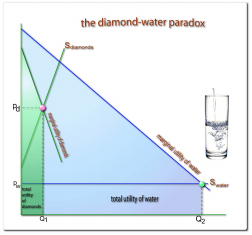
Through the past week here at the Virginia Governor’s School, we have had the pleasure of learning from Dr. Mike Ellerbrock, a brilliant economist, who has illustrated the universality of economics. He first started off the class by explaining the diamond-water paradox and how the cost of something depends on the level of consumption. It is very important when comparing the cost of two items to look at the same unit of each item to do a fair comparison. Leading off of that, Dr. Ellerbrock basically explained to us that economics is basically a mesh between mathematics and psychology. Dr. Ellerbrock mentioned that economics is used everyday and that everyone should be educated in the ways of economics for their own benefit. Furthermore, Dr. Ellerbrock says it is important to not only look at the physical cost of doing something but also the hidden opportunity cost that is in each purchase. Like when you attend college, the cost is not only the tuition and room and board, but also the lost income you could have made if you got an entry level job. Economics education teaches kids about how to fix or analyze some of these issues so that they make better decisions for their future. Especially in the Old Dominion State, economic education is vitally important not only to economists, but to everyone. Take the FFA for example, Future Farmers of America, they are a school club that boasts members all across the commonwealth that prides itself on educating the future agriculture leaders of Virginia in smart and safe farm practices. This type of education is vital to not only earning a livelihood, but it is also important in helping bridge the wealth and education gap that exists between Northern and Southern Virginia. More clubs and organizations should be encouraged to do the same thing, teach kids how to get the most out of their work and how to be safe in doing so. Not only is this education vital for providing food, but it also influences the safer and more eco-friendly farming practices. Seems like farm education is a win-win. Economics plays an important role, and will continue to shape the livelihood and profitability of farms both small and large. Maybe it’s time that we gave econ the credit it deserved in the classroom, or at least taught it in every classroom because right now 38 States don’t require and economic or personal finance class.
Until next time,
Riley, Todd, Aaron, and Eugene

References
Iowa State (n.d.). The diamond-water paradox [Infographic]. Retrieved from
http://www2.econ.iastate.edu/classes/econ101/choi/images/c765.jpg.